
My body story, and the word I am taking back
I leave my body on purpose. I believe it is one of the most embodied things I do.
I know how that sounds. Much of somatic work teaches embodiment as being in the present, feeling an experience, and coming into relationship with yourself. Detachment gets cast as the villain of that story.
My story is one of detachment to nourish embodiment. And when the story involves a little astral projection, that healthy detachment becomes something sprinkled with a little magic - and who can’t use a little magic to nourish the soma every now and then?
A Body Was Simply a Body
The funny thing about shadows is that they often don’t appear as shadows to those walking in them.
I grew up in a house where a body that worked uniquely was simply a body. My father began dragging his legs at 24, during his second tour in Vietnam, and by the time I knew him as my dad, his condition was not a condition in my mind - it just “was.” Just as I have 10 fingers, my dad just couldn’t walk and his hands shook. I never once saw his as a “less-than” body.
I remember family who meant well telling us they were “so sorry” he had to deal with that, and I remember how much it irritated me. It felt like a pity forced onto a man who did not feel that way about himself, and onto his daughters who were just living life with their father.
My sister began dragging her legs as a young teenager. In my adulthood, my own legs started to grow stiff, and my walk, which had always been a little clumsy, slowly changed. I was completely aware that what my brain was asking my limbs to do was not always carried out as my brain had requested.
The three of us moved through space and time with a shared invisible shadow that connected us. We knew we were the same, but we were told we were different from each other. Three people, clearly with the same condition, each handed a different diagnosis.
That soup pot of diagnoses took away a chance to honor the precious connection that only my dad, my sister, and I shared. It caused me to unknow the part of me with the stiff legs and the part of me that would randomly fall to the ground. I pushed it into an “unknowing vault” deep in my psyche, where it lived as a dark shadow.
That was dissociation. Hold onto that, because it is very different from the healthy detachment I started this story with.
Glowing Reviews and Less-Than Scores
My father wasn’t trying to teach us lessons by living fully. He wasn’t his disability, and he wasn’t not his disability. He was just living.
Growing up knowing my dad’s condition wasn’t a “less-than” thing gave me my first body image, and it was a good one. His living taught us that you need a body to live, so you can get to living in that body or you can begrudge it. My body image was rooted in a glowing review I gave myself. It came from how my body felt to me from the inside, and it never felt like something that could be taken from me.
The child my father raised would become a woman, and that woman would one day learn of the scores imparted by judges who lived outside her father’s home.
The Scorecard I Never Saw
I lived. I served in the military. I married. I became a mother. I divorced. I was still rooted in a glowing body image, and I was not just living in my post-divorce era, I was thriving. I took care of myself and my son, and I was ready to date confidently. I truly did not see my stiff legs as anything to think about.
So it never occurred to me that a suitor would flinch about those legs of mine not quite bending when I walked in to meet him in person - but flinch they did.
A shadow is easier to see for those not standing in it. The online-turned-in-person suitors didn’t see me as just living. They read my body from the outside, saw a “less-than” body before them, and that score often meant a date or two and then silence.
I did not see the scorecard while it was happening. It was only after I met my husband, and we had been together for several years, that I looked back and saw the whole picture. I had been so busy living that I had not seen the judges casting their votes.
I was fine with my body. I was angry that it had been judged, and that anger made me wonder where else the scoring had been happening without my noticing. My family’s pity and a stranger’s ghosting come from the same place: a culture that reads a different body as a lesser one and then assumes the person inside agrees.
The anger sent me to my father. I called on his spirit, the fighter, the positive one, the one who never saw his disability as a shortcoming. I started advocating and speaking openly instead of just being. I came into relationship with the shadow that had always been looming, and I got my groove back, literally. My flare-ups often relaxed.
The Relief of a Name
For years, doctors filled the soup pot with the wrong diagnoses - multiple sclerosis, a spine injury, an ankle injury. The right one was a relief. My shadow finally had its name: hereditary spastic paraplegia, or HSP.
A name meant a path, actual help, and the chance to know myself instead of walking in a body that was doing something I was kept in the dark about. It was time to welcome her to the table and make up for lost time.
HSP is here to stay. But I cannot think of a more profound show of how living embodied, in a friendly relationship with ourselves, can change the soma.
The Table, the Cave, and the Woman by the Sea
My own somatic practice includes rest, meditation, going within, and detaching. I build an inner landscape and settle into deep relaxation inside it. I do not try to control my mind when it wanders, and I do not try to fix a body part when it fidgets or twitches. Coming to a state of noticing is what calms me.
The clearest experience I have had of this came when I got to rest and be tended to. I became so relaxed in a healing session that I entered a deep meditation, and from there I went somewhere else entirely. I can only call it astral projection.
I was in conversation with my ancestors, with ancestral women in a cave, and with a woman who sat beside me on a rock by the sea and told me many things. It was embodiment at the ancestral level. It had no guard rails. I did not have to feel healed, or be freed of fear, or know anything.
I knew that in some way I had left my body, yet I have never felt more present in it.
Welcoming Detachment to the Somatic Table
I truly love the act of reclaiming a word, and detachment is my current word to reclaim.
Detachment has been made the villain of embodiment. It is treated as the opposite of being present, as though to detach is to stop experiencing and feeling. In somatic and trauma work, leaving the body is most often discussed as dissociation, something to be repaired.
Here is the difference as I live it. Dissociation moves a person away from something unbearable, and there is no chosen way back. Detachment can become unhealthy too, because remaining detached leans into avoidance.
Healthy detachment is something different. It is chosen, it moves toward something, and it always comes home. It is a rising above and away from the noise for a while.
When I practice, I turn the outside down: gentle scents, soft sounds, low light. That asks my own senses to create the sight, smell, sound, and feeling from within. A calm sourced from deep within is the calm my system seeks and cannot reach through the continuous sensory input of our modern culture.
With the outside quiet, I feel a settling in my chest and lungs. My breath is my beacon, my first signal for both red flags and safety.
And then the most surprising part. In this state my body feels weightless, the opposite of the dense, tense limbs I walk with. Letting go once felt like a loss of control. I see it now as an opportunity to discover what a body not recoiled by life’s demands actually feels like. For a body with spastic legs, that is no small discovery.
Detachment is also how I reach what is buried. Ancestral messages are heard the clearest when I rest, rise above myself, and listen to the quiet. Whether that is viewed as deep relaxation, detachment, astral projection, or magic, it is nourishment to my embodiment.
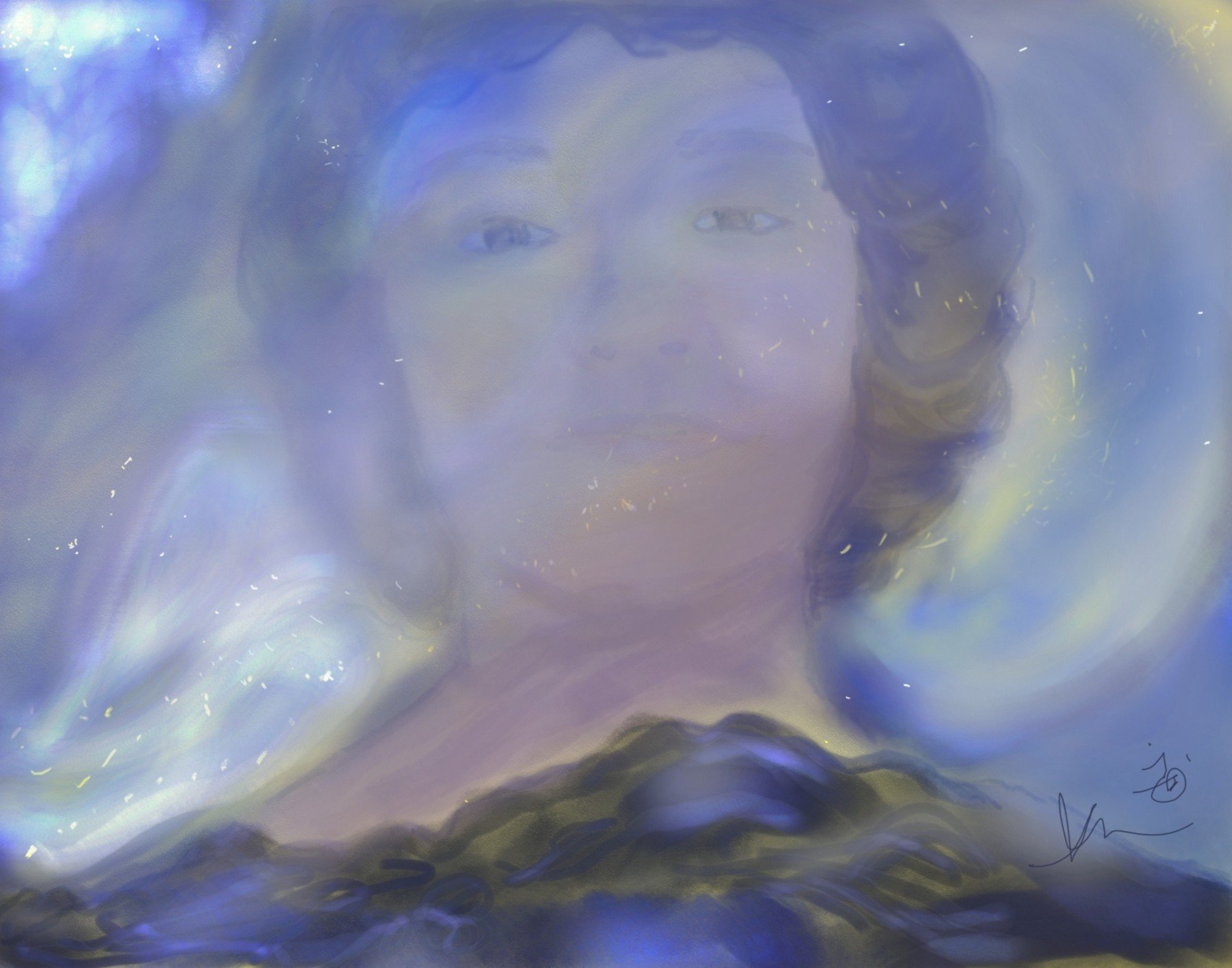
The night my mother passed, I could not sleep. In the dark, as morning was approaching, I closed my eyes as my sister slept next to me, and I asked my mom to show me where she was and to let me know if she was ok. I saw her as the northern lights, filling the night sky over mountains, dancing and swirling, free of earthly worries, headed to where she was going - on her way to Heaven, and maybe a stop with the ancestral women in the cave. Her own little astral projection journey to the heavens. I drew what I saw.
The Return
What makes detachment healthy is the return.
I used to believe that time to myself was my only path to a reset. I have come to learn that my calm is an ecosystem. I do not only thrive on exchanging energy with others, and I do not only thrive on healing in solitude. I need both. Time to myself is the nourishment I require to return to, contribute to, and appreciate the collective.
My father never mentioned leaving his body behind, but he did talk of our ancestors like friends at the corner pub. Sometimes I wonder if he ever sat on the rock at the mouth of the cave, somewhere beyond his body, to commune with those who wove our history long before us.
How thankful I am for the gifts he filled my soul with, gifts that allow my shadow and my glow to live in relationship with each other. Who knows where I will soar to, and what my detached flight will bring back to nourish my soma.
Shannon
Curious what a chosen flight feels like? Astral Projection Night is on the winter calendar at Buttercup Cottage.
